
Description
VAC functionality is similar to the "Stereo Mix" ("What You Hear" or "What U Hear") feature implemented in some hardware audio adapters (cards). But it is only similar, not equivalent. If you simply need a function like "Stereo Mix" under Vista/Win7/Win8/Win10, there could be better to try to enable it in your audio adapter.
Features
- Works in Windows 11, 10, 8.1, 8, 7, Vista and XP systems (x86, x64 and arm64 platforms).
- Offers up to 256 Virtual Cables. Each Virtual Cable is a one-way audio transport between applications, so you can transfer up to 256 independent audio signals between applications at the same time.
- Less than 1 ms latency with the appropriate driver and application settings.
- Almost any of fixed point PCM audio formats (1000..384000 samples per second, 8..32 bits per sample, 1..32 channels).
- PCM format conversion (sampling rate, bits per sample, number of channels).
- RT Audio (WaveRT) protocol support with notification events, packet mode, clock and position registers. Clock registers are bound to Virtual Cables so all streams in each cable are coherent.
- Unlimited number of Kernel Streaming clients. You can share each Virtual Cable between any number of KS-aware audio applications or ASIO wrappers, at the same time with WASAPI Exclusive Mode connection.
- Signal mixing from all render/playback streams in each Virtual Cable. You can mix signals from several applications in real time.
- Signal volume control features (both attenuation and boost).
- Channel scattering/gathering mode. Using KS-aware applications, you can remap particular channels in a stream.
No audio hardware required
To use VAC for digital audio transfer, you need no audio hardware (sound adapter/card), either built-in or external. Audio hardware is required only to hear the results, or to record signals from external sources. On a computer with no audio adapter (card), you still can use VAC to route and/or record audio signals produced by applications (for example, on a remote server).
Control panel application
VAC Control Panel application allows you to change number of Virtual Cables, view/modify VAC driver and cable settings, watch for cable/stream activity.
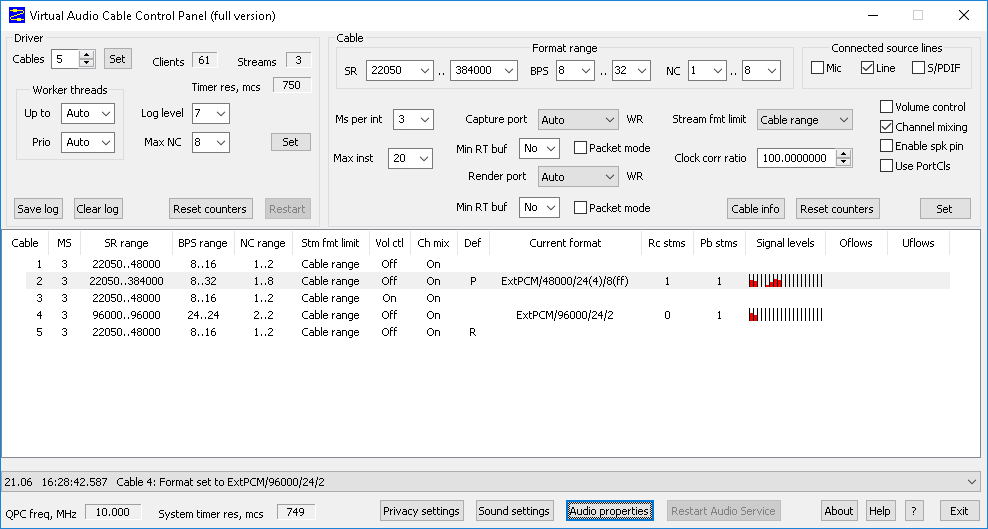
To open VAC user manual, just click the "Help" button.
Device-to-device audio transfer
Virtual Cable devices (endpoints) allow you to organize application-to-application audio transfer only. To perform endpoint-to-endpoint transfer, use Audio Repeater application included into product package.
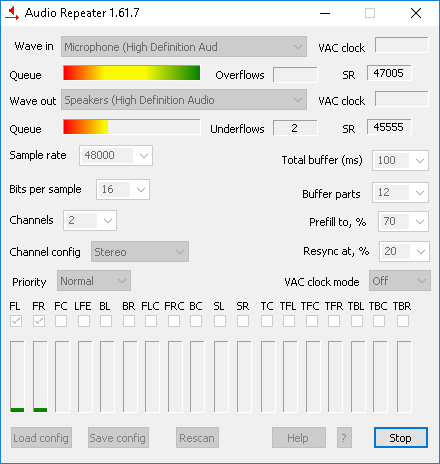
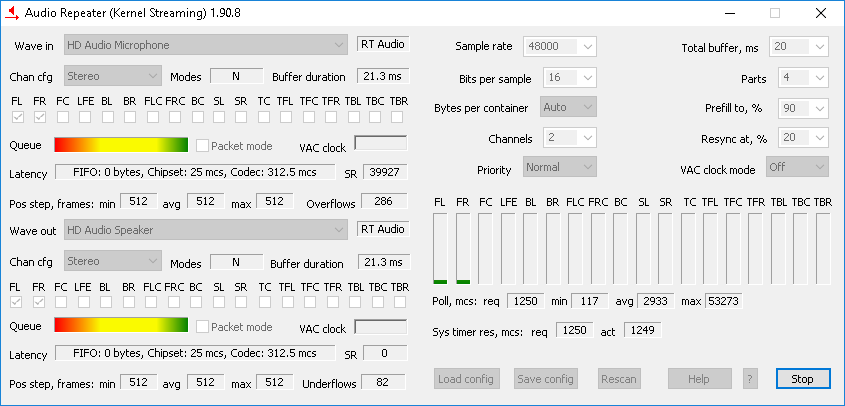
Both Audio Repeater versions (MME and KS) can be used free of charge, independently of the main VAC product. Trial VAC package contains the same fully-functional Audio Repeater binaries as the full version package.
Driver-based solution
VAC contains Windows WDM/KS virtual device driver that creates virtual audio devices. This driver is a kernel-mode module, and needs to be installed with administrator rights.
Being a WDM/KS filter, VAC represents a lowest-level audio layer in Windows. It can be effectively used by any upper-level layer (KS-aware applications, WASAPI, MME or DirectSound subsystems, ASIO wrappers and so on).
Comprehensive user manual
VAC user manual is directly available on the web and is also included into each distribution package available on the download page. It contains many details useful for better understanding the product and using it correctly. User manual is built in CHM format, convenient for both read and keyword search.
You can read the user manual offline, getting an advantage of the keyword search feature, without installing trial version in the system. Just download and run the installer's EXE file, and click the "Help" button in the first installation dialog. After reading the manual, abort the installation.
If you prefer to avoid running the executables, just download a ZIP package, extract the file named "vac" and marked by a question mark icon (the "chm" extension), and open it.
If no text is displayed in the right pane, close manual window, copy manual file, paste it into any folder, right-click the pasted file, select "Properties", find the "Unlock" or "Unblock" button or checkbox, confirm unblocking, and open the unblocked file.
To find information related to some issues, enter the appropriate keywords in the "Search" tab. For example, "microphone", "speaker", "crackling", "broadcast" and so on.
Keyword search feature is not available in the online manual version.